Macro Intelligence · Understand markets
Read the regime before you read the price.
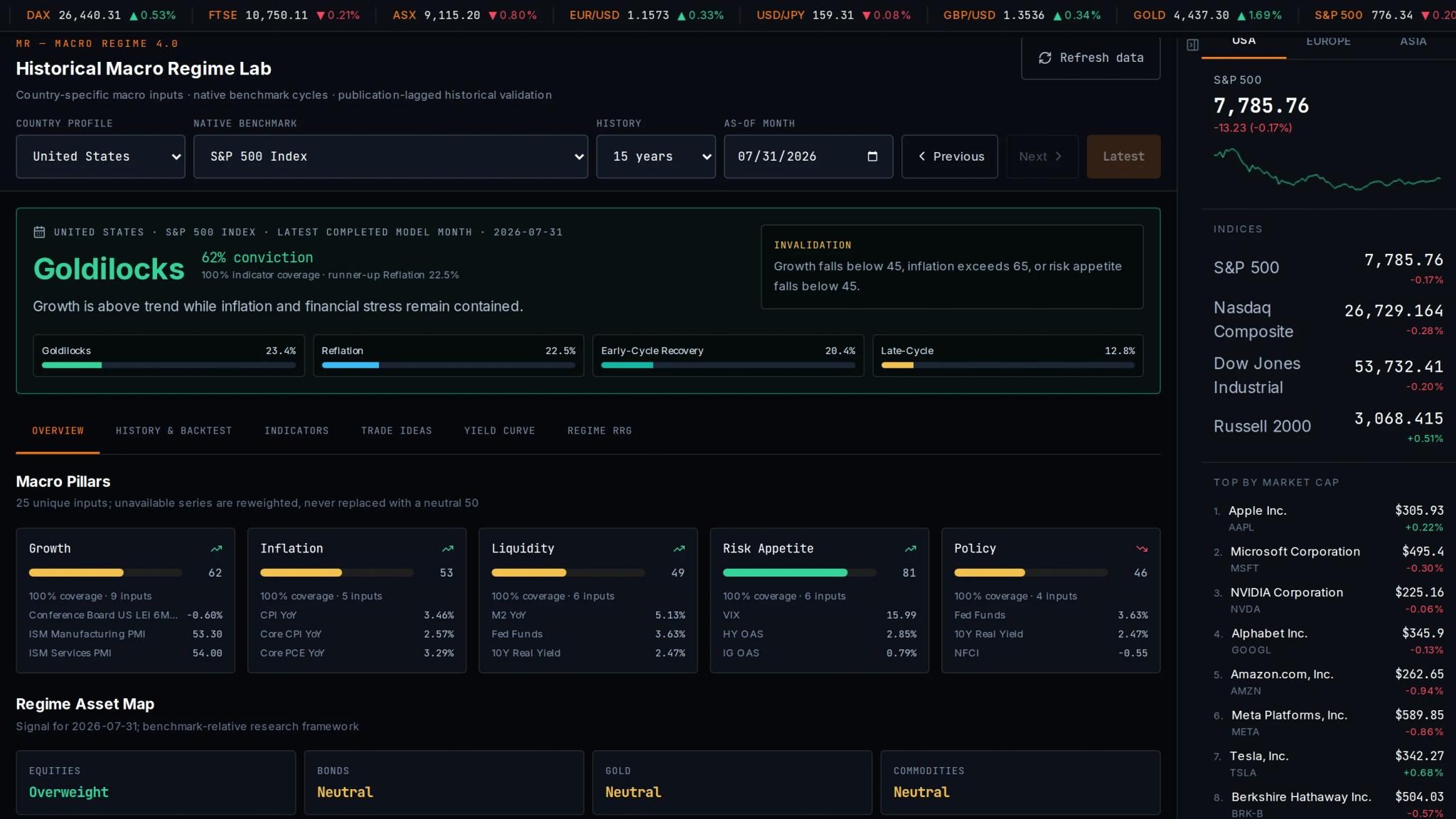
Growth, inflation, policy and liquidity, captured on each release and combined into one regime view, with its conviction and the conditions that would change the call on screen.
Questions it answers
What a desk asks of it.
- Did the latest release change the regime, or only the headline?
- What is the market pricing for each central bank, meeting by meeting?
- Is liquidity adding to risk assets or draining them?
- Which currencies are trading away from their macro drivers?
What it includes
The modules in Macro Intelligence.
Each one is a working window in the terminal, opened by the code shown.
- MR
Macro Regime
Classifies the regime for a country against its own benchmark from 25 inputs across growth, inflation, liquidity, risk appetite and policy. Shows conviction, the runner-up regime and the conditions that would change the call. The history is rebuilt point-in-time, so every backtest sees only what was known on the day.
- RF
Rate Forecast
Meeting-by-meeting policy paths for the major central banks, solved directly from market pricing with the same construction professional rate desks use.
- FXM
FX Macro Model
A relative macro model for 11 currency pairs: rates, growth, data surprises, inflation and risk scored as rolling z-scores, with a fair-value estimate where the model's out-of-sample fit earns one.
- EI
Economic Indicators
Leading, coincident and lagging indicators for 47 countries, each with its latest period and the change on the year.
- BC
Business Cycle
Investment-clock phase from growth and inflation scores, with the indicators behind each score and 24 months of phase history.
Top-Down Workflow
An eleven-step top-down chain: global PMI scan, cycle, regime, liquidity, financial conditions, breadth, sector momentum, rotation, screen, valuation, and the conviction that results.
- CAL
Calendar
Economic and earnings calendars with consensus, prior and actual.
- CMD
Commodities
Energy, metals and agriculture: futures curves, storage, regional markets and agricultural supply.
- PWR
Power & AI Load Desk
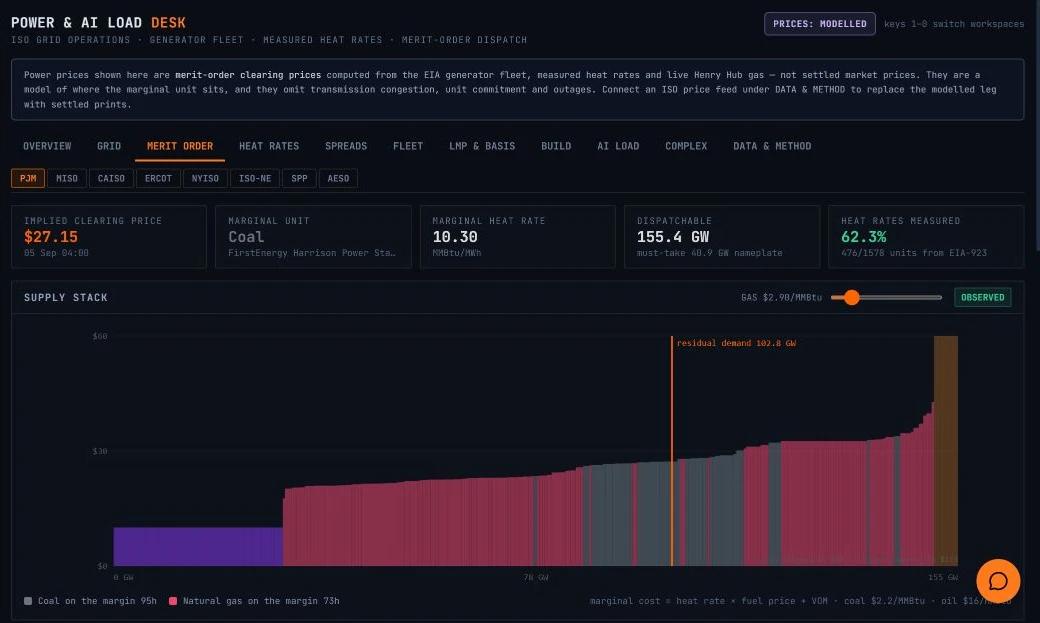
Power and AI data-centre load: merit-order pricing built unit by unit from the generator fleet, checked against settled market prices.
Method
How the output is built.
- Point-in-time by construction
- Every input is stamped with the date it was first published, so a historical read never sees data that did not exist yet. Backtests show what you could actually have known.
- Coverage you can see
- Each score prints how many of its inputs are live, so conviction always reflects the evidence behind it.
- Conclusions carry their exit
- Each regime read states the conditions that would overturn it, so the view can be monitored rather than re-argued.
What your team gets
The outcome, not the feature list.
- A shared regime view the whole team works from, updated as each release lands.
- The policy path for every major central bank, meeting by meeting, in one place.
- Backtests you can defend in committee, because they only use data that existed at the time.
Used by
Next: Equity IntelligenceHedge Funds
Macro, long/short and systematic desks that need the regime, the read-across and the crowding in one place.
Family Offices
Small investment teams that need institutional research coverage without a room full of terminals.
Asset Managers
Research and allocation teams that need point-in-time macro inputs and benchmark-relative risk.
Portfolio Managers
The daily loop: what changed, what the book is exposed to, and what would change the view.
Research Analysts
Filings, segment data, relationships and macro series that can be traced back to their source.
Request a demo
See it on your own questions.
A demo is a working session in the platform on a question you bring: a release, a company, a position or a portfolio. We reply within two business days.